Figure 1: A simulated radiation cascade at a grain boundary. Only atoms that deviate from the equilibrium structure are visible.
Structural metals play a critical role in many nuclear systems, yet we still lack a complete understanding of how they respond to radiation. When a high-energy particle such as a neutron strikes an atom, it can initiate a collision cascade (Figure 1) in which displaced atoms transfer energy to their neighbors. As the cascade dissipates, some atoms fail to return to their original positions, leaving behind vacancies and interstitials. These point defects increase the energy of the crystal and may either recombine or accumulate into larger defect clusters.
Most engineering metals are polycrystalline, consisting of many grains separated by disordered grain boundaries. These boundaries often act as sinks for radiation-induced defects, absorbing vacancies and interstitials that would otherwise accumulate in the crystal. However, not all grain boundaries behave alike. Some produce large defect-free regions known as denuded zones (Figure 2), suggesting that grain-boundary engineering may provide a route toward more radiation-tolerant materials.
Approach
- Molecular dynamics simulations of collision cascades in polycrystalline metals.
- Repeated irradiation of the same microstructure using high-energy primary knock-on atoms.
- Thermal equilibration between cascades allowed defects to migrate, cluster, and recombine.
- Comparison of defect accumulation and absorption near different grain boundaries.
Results
Grain Boundary Region Evolution
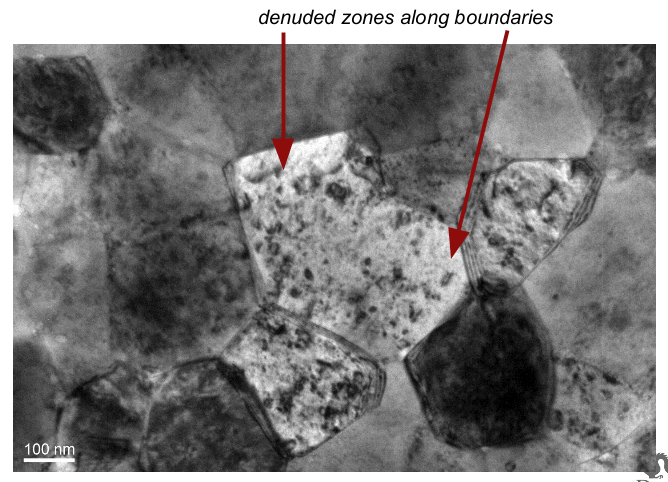
Figure 2: TEM image showing an iron think film with a columnar microstructure, where the central grain exhibits denuded zones along some boundaries.
Interactions between point defects and grain boundaries occur over very short distances and times, nanometers and picoseconds. This presents signficant challenges for experimental work. While various imaging techniques can reveal certain aspects of these processes, methods are expensive and each presents it's own limitations. This presents a good opportunity for simulation to aid experimental work. Atomistic simulation, where a material is treated as a collection of atoms which each individaully move according to Newton's laws of motion, typically measures lengths in nanometers and times in picoseconds. A perfect fit!
We wanted to understand why some grain boundaries seem to absorb defects more readily than others. To probe this in simulation, we created a system representing a thin film of iron with a columnar microstucure, where each grain spans the full thickness of the film. We simulated irradiation by randomly selecting an atom and giving it a large amount of kinetic energy in a random direction. We repeated this process thousands of times, to see how a microstructure might begin to evolve under irradiation. The video in Figure 3 shows how the energy of the film changes with more irradiation events. Clearly, changes in energy are concentrated at the grain boundaries, and some grain boundaries in particular seem to change much more than others.
Figure 3: Evolution of a columnar nanocrystalline system subjected to many radiation events.
Despite the large number of cascades generated, each grain boundary typical had a relatively small number of defects nearby, which made quantification difficult. By categorizing each grain boundary as 'denuded' or 'non-denuded', we were able to calculate the change in energy, a proxy for defect concentration, as distance increased from each type of boundary (Figure 4). The two types of boundary show a clear distinction, but actually both types have a dip in concetration well below the baseline, but the 'denuded' group's dip occurs much closer to the grain boundary. The mechanism behind this effect, but this provided quantative evidence that different types of grain boundaries interacted with defects in different ways.
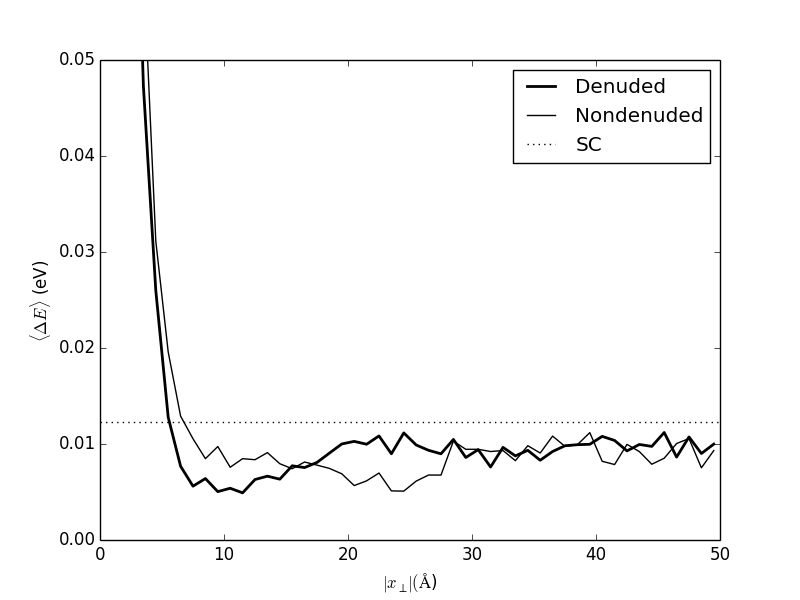
Figure 4: Comparison of local neighborhoods of grain boundaries qualitatively labeled as 'denuded' or 'not-denuded' based o eyeballing local defect concentration. The response on a single crystal (SC) subjected to the same radiation load is shown for comaprison.
The columnar polycrystalline presented problems for characterizing the types of grain boundaries; we could see two different types but not what features made them different. Meaningful quantification of arbitrary grain boundary structure remains an active area of research, and was well beyond the scope of this project. Instead, we shifted the focus to individual grain boundaries whose structure we could control.
When a grain boundary is formed between two neighboring crystallites, the equilibrium structure of the grain boundary is defined to a degree by the relative orientations of the two grains. When the grains have certain specific orientations, the equilibrium grain boundary structure may be almost as ordered as the parent crystal structure. Real systems, however, often exist far from equilibrium and all grain boundaries in real life have some degree of non-equilibrium character, and thus exhibit significantly more disorder. We hypothesized that this non-equilibroum character may play a role in interactions between grain boundaries and poitn defects.
We created two sets of grain boundaries: one of equilibrium structures of specially oriented grain boundaries and another of these same boundaries but in a non-equilibrium state after a significant artifical disordering. We subjected these grain boundaries to many independent radiation events. In the aftermath of these cascades, the equilibrium grain boundaries exhibited larger clusters of remaning point defects, suggesting the non-equilibrium boundaries acted as a much more efficient defect sink (Figure 5).
Grain Boundary Structure Evolution
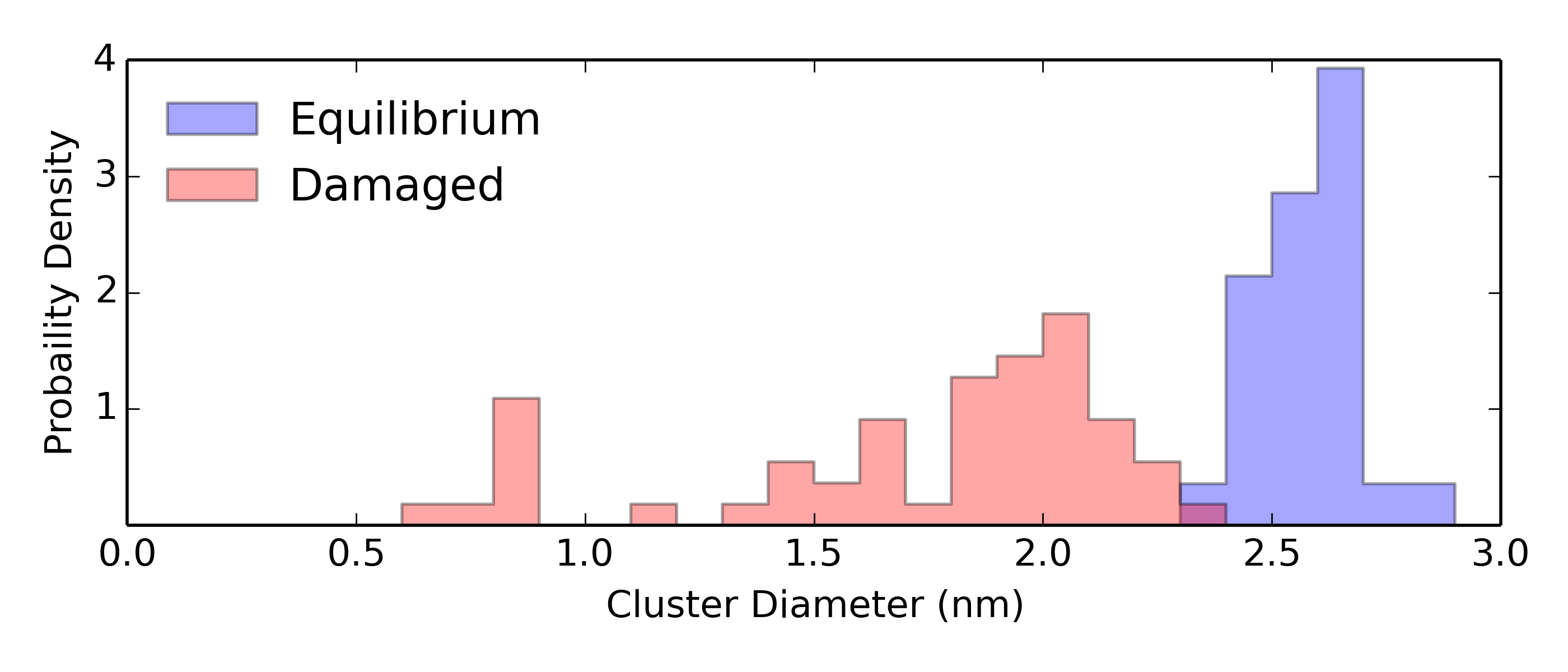
Figure 5: Distribution of defect cluster size after a single radiation event on a grain boundary in both equilibrium and damaged states.
Further evidence for this effect appears in the change in energy of the grain boundary afterks a radiation event (Figure 6). After irradation, equilibrium boundaries always increased in energy, while non-equilibrium boundaries could increase or decrease, retaining the same energy on average. As the equilibrium structure is already at the lowest possible energy, and change has nowhere to go but up. In contrast, the non-equilibrium boundary may be able to lower it's energy when a defect interacts with pre-existing damage in a favorable way. Systems prefer to go towards lower energy states, so non-equilibrium boundaries have greater potential to act as defect sinks than those in equilibrium.
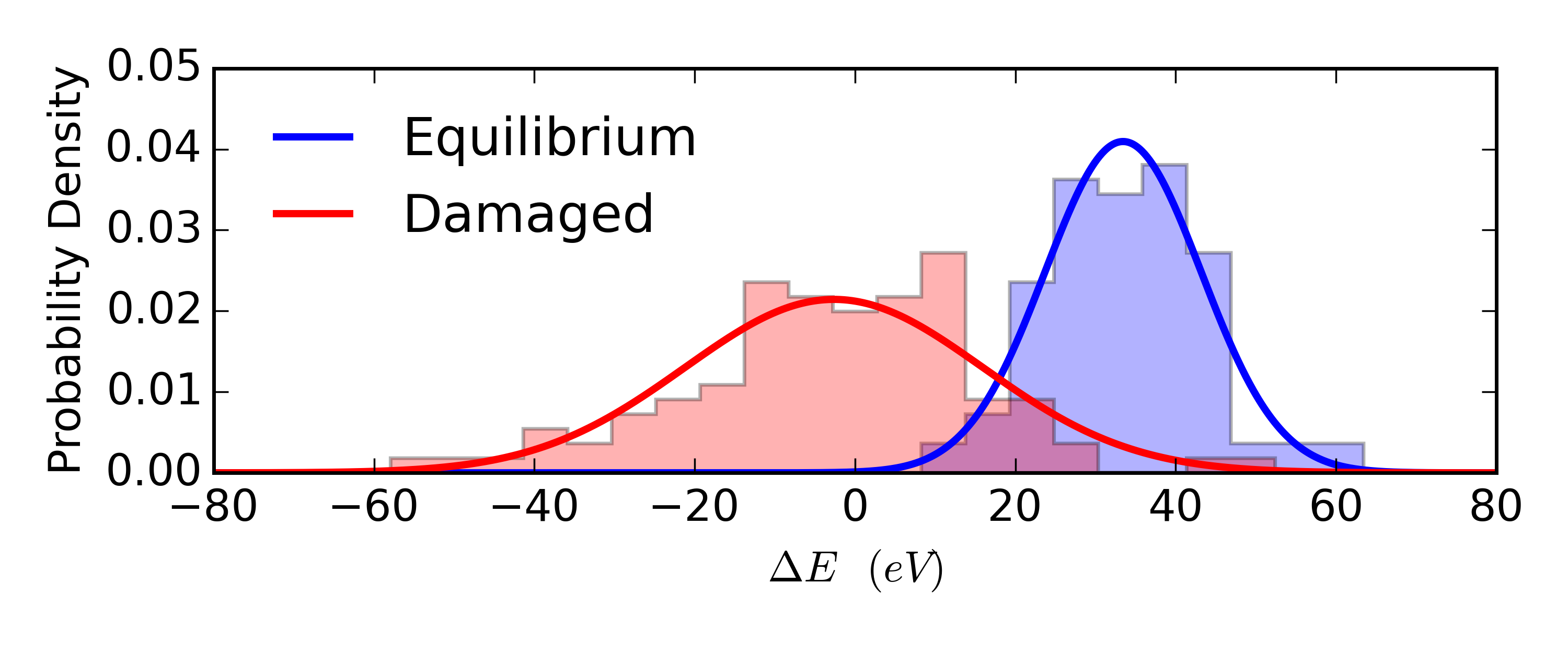
Figure 6: Distribution of change in total system energy.
Conclusion
We were able to establish that different types of grain boundaries have significantly different ability to accomodate damaage, supporting experimental results. The non-equilibrium character of boundaries suggests on way in which individual grain boundary character might effect this difference. This motivates ongoing work in quantifying grain boundary structure beyond the orientations of the parent grains, but focusing on the specific atomic arrangements present in each boundary. If we could succeed in this task, this might provide a way to engineer damage tolerant microstrucures with a high concentration of damage-accomodating boundaries.
Further Reading
Achieving Radiation Tolerance through Non-Equilibrium Grain Boundary Structures
G. Vetterick, J. Gruber, P.K. Suri, J.K. Baldwin, M.A. Kirk, P. Baldo, A. Misra, J. Griggs, G.J. Tucker, M.L. Taheri
Sci Rep
(2016)
[link]