Most engineering metals are polycrystalline: they are composed of many individual grains. As the grain size decreases into the nanocrytsalline regime, grain boundaries, the interfaces between grains, begin to dominate mechanical behavior.
Atomstic simulation is an excellent tool to study grain boundaries, which are often only a few atoms wide. Most simulations of these systems, however, utilize a naive microstructure generation method that often produces unrealistic systems.
In this project we showed that the microstrcuture generation method can have real effects that meaningfully influence macroscopic mechanical behavior, specifically by influencing the interplay between dislocation and grain boundary plasticity.
Approach
We compare the common Voronoi tesselation microstructure generation method against microstructures produced by phase-field grain growth simulation.
Voronoi tesselation methods are cheap and simple, but commonly generate unrealistic grain shapes and grain boundary networks. Among the problems are unstable thin grain geometries, artificially narrow grain-size distribution, and overabundance of planar grain boundaries.
?toggle help
uniformdistribute n points uniformly
poisson diskattempt to distribute n points using a poisson disk distribution with radius r
nnumber of points
rminimum distance between points in the poisson disk distribution
click and drag to pan the voronoi diagram
Figure 1:Grain Structure Generation
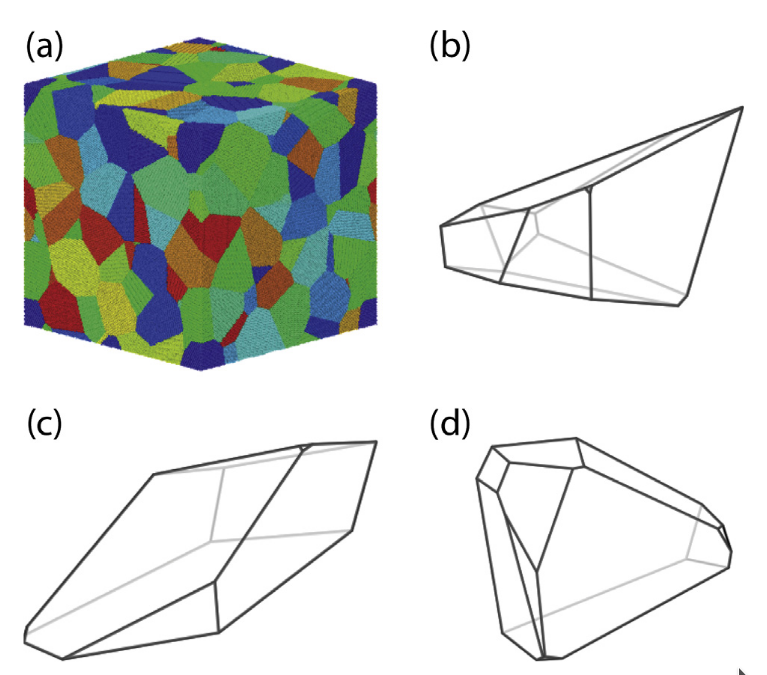
Figure 2:Unphysical Voronoi Grains
Example Voronoi microstructure with selected unphysical grains.
The phase-field method models microstructure evolution through minimization of the grain interface energy. Morphologies more closely match real systems and the interface energy function can account for material anisotropy or grain boundary variety.
Figure 3:Phase Field Microstructure Evolution Simulation
Example simulation of microstructure evolution by solving the isotropic Allen-Cahn equation.
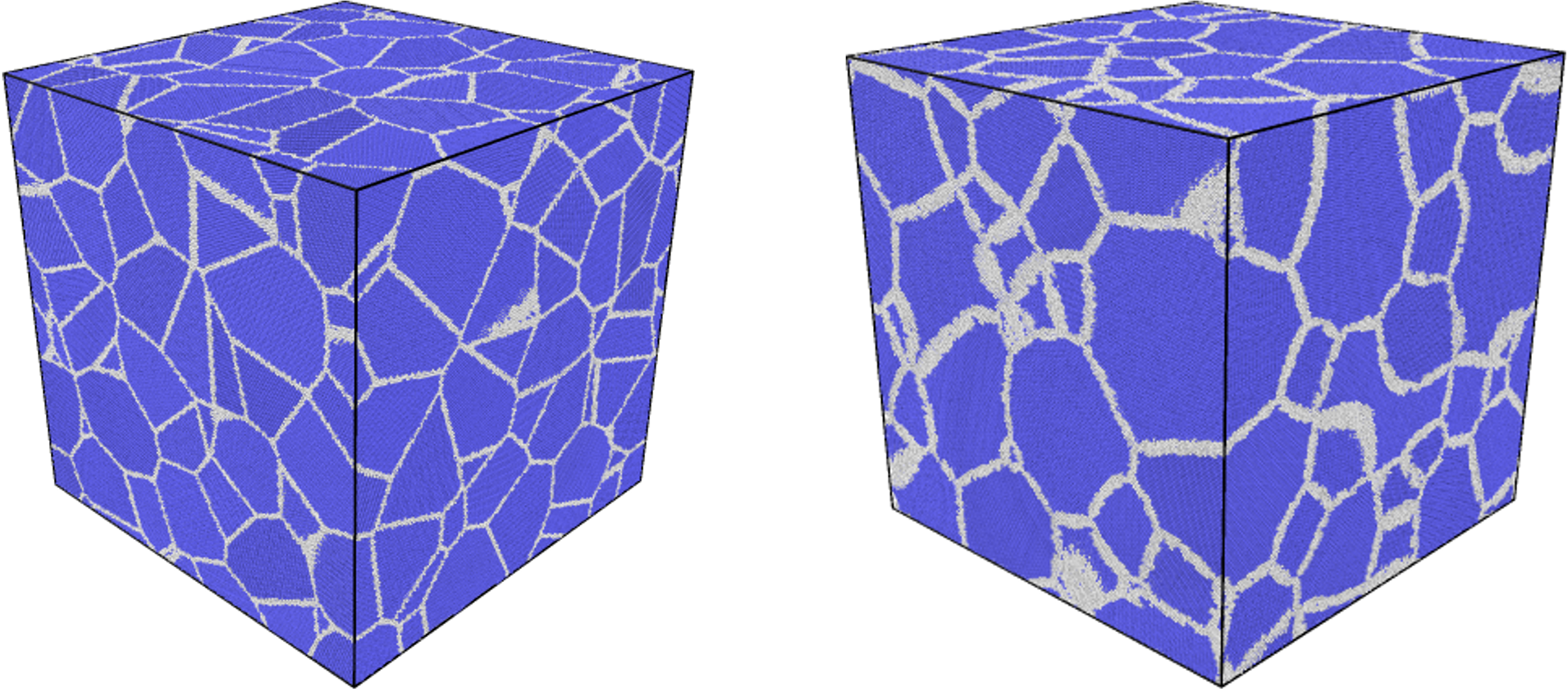
Figure 4:Microstructure Comparison
Microstructure Comparison. (left) Voronoi tesselation. (right) Discretized phase field model
Results
In uniaxial compression, the choice of microstructure generation method significantly altered how the material deformed under tensile loading.
Phase-field-derived microstructures exhibited substantially more dislocation activity, while Voronoi microstructures relied more heavily on grain-boundary-mediated deformation. The flat boundaries and narrower grain-size distribution of the Voronoi microstructure promote dislocation plasticity, while the phase field microstrucre, despite having a lower total grain boundary area, favors grain bounday sliding.
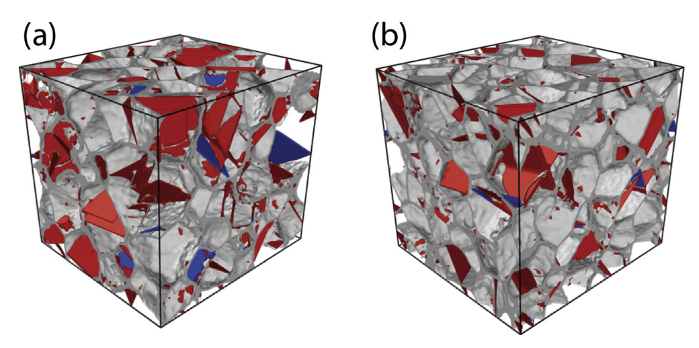
Figure 5:Dislocation Visualization
Visualization of perfect (blue) and partial (red) dislocations within deformed samples of both microstructures.
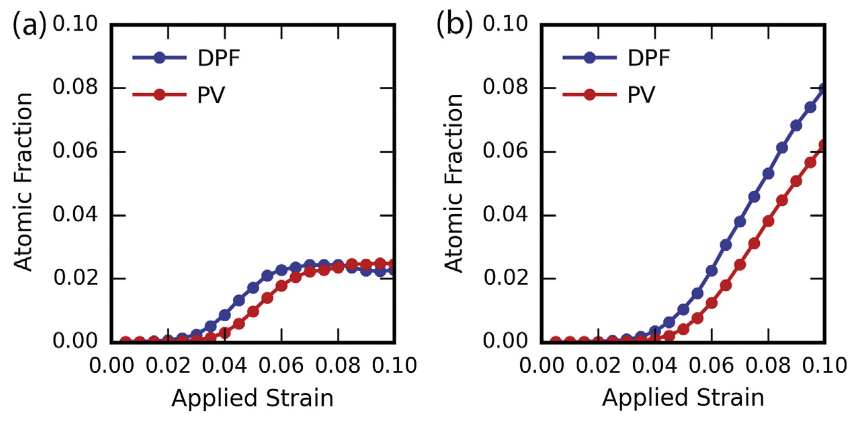
Figure 6:Dislocation Quanitification
Strain accomodated by dislocations in each microstructure. Phase field microstructure exhibits significantly more dislocation activity.
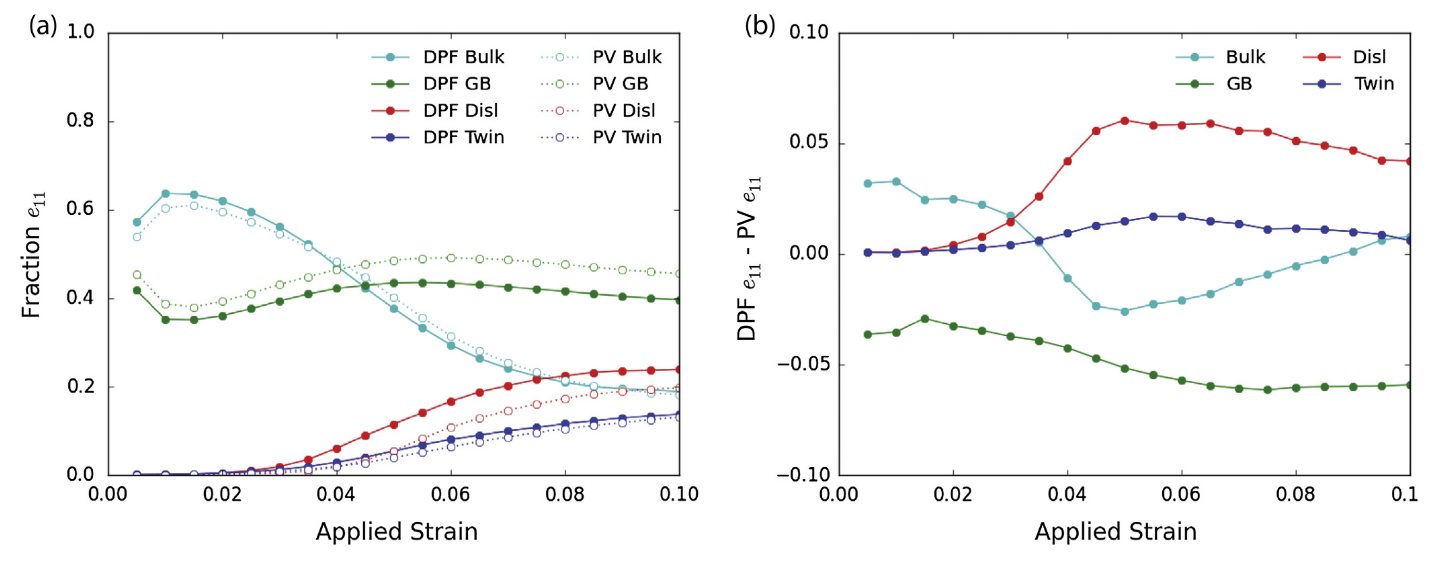
Figure 7:Strain Mechanism Quantification
Quantification of strain accomodated by various deformation mechanisms for both microstructures. Voronoi tesselation prefers grain boundary sliding, while the phase field microstructure promotes dislocation activity.
Conclusion
The balance between dislocation plasticity and grain-boundary-mediated deformation governs the strength and ductility of nanocrystalline materials.
This work demonstrated that seemingly minor differences in grain-boundary geometry can shift the dominant deformation mechanisms in atomistic simulations. Accurate prediction of nanocrystalline behavior therefore requires physically realistic microstructures, not just physically realistic interatomic potentials.
The methodology developed here was subsequently used in multiple studies of nanocrystalline mechanics and helped motivate related approaches based on other mesoscale grain-growth models.
Further Reading
Development of physically based atomistic microstructures: The effect on the mechanical response of polycrystals
J. Gruber, H. Lim, F. Abdeljawad, S. Foiles, G.J. Tucker
Computational Materials Science
(2017)
[link]
On the mechanistic origins of maximum strength in nanocrystalline metals
A. Gupta, J. Gruber, S.S. Rajaram, G.B. Thompson, D.L. McDowell, G.J. Tucker
npj Computational Materials
(2020)
[link]
Grain-Size-Dependent Grain Boundary Deformation during Yielding in Nanocrystalline Materials Using Atomistic Simulations
S.S. Rajaram, A. Gupta, G.B. Thompson, J. Gruber, A. Jablokow, G.J. Tucker
JOM
(2020)
[link]