Layered crystalline materials are those where the atomic structure creates relatively uniform properties in two directions (within the layers) and divergent properties in a third direction (between the layers). For example, the bonds within the honycomb layers of graphite approach the strength of diamond, while the bonds between the layers are about as strong as the adhesive of office tape.
One outstanding problem in layered materials has been their response to mechanical deformation. Crystalline materials are typically thought to deform via either bond stretching (elastic deformation) or the movement of defects known as dislocations (plastic deformation). However, in certain loading conditions, many layered materials, can accomodate a large compressive deformation that is incompatible with both conventional elastic and plastic behavior. To investigate this behavior, we considered the presence of ripples on individual layers within graphite, which we termed "ripplocations".
Approach
Initially, we approached this phenominologically primarily through atomistic simulation supplmented with microscopy from neutron-irradiated MAX phases.
Results
Direct evidence for buckling in layered crystals
Our first thrust was determining whether the addition of "excess units of material" could produce single-layer buckles in graphite, and whether these would match the structures we saw in TEM. Initial evidence showed a pretty reasonable match.
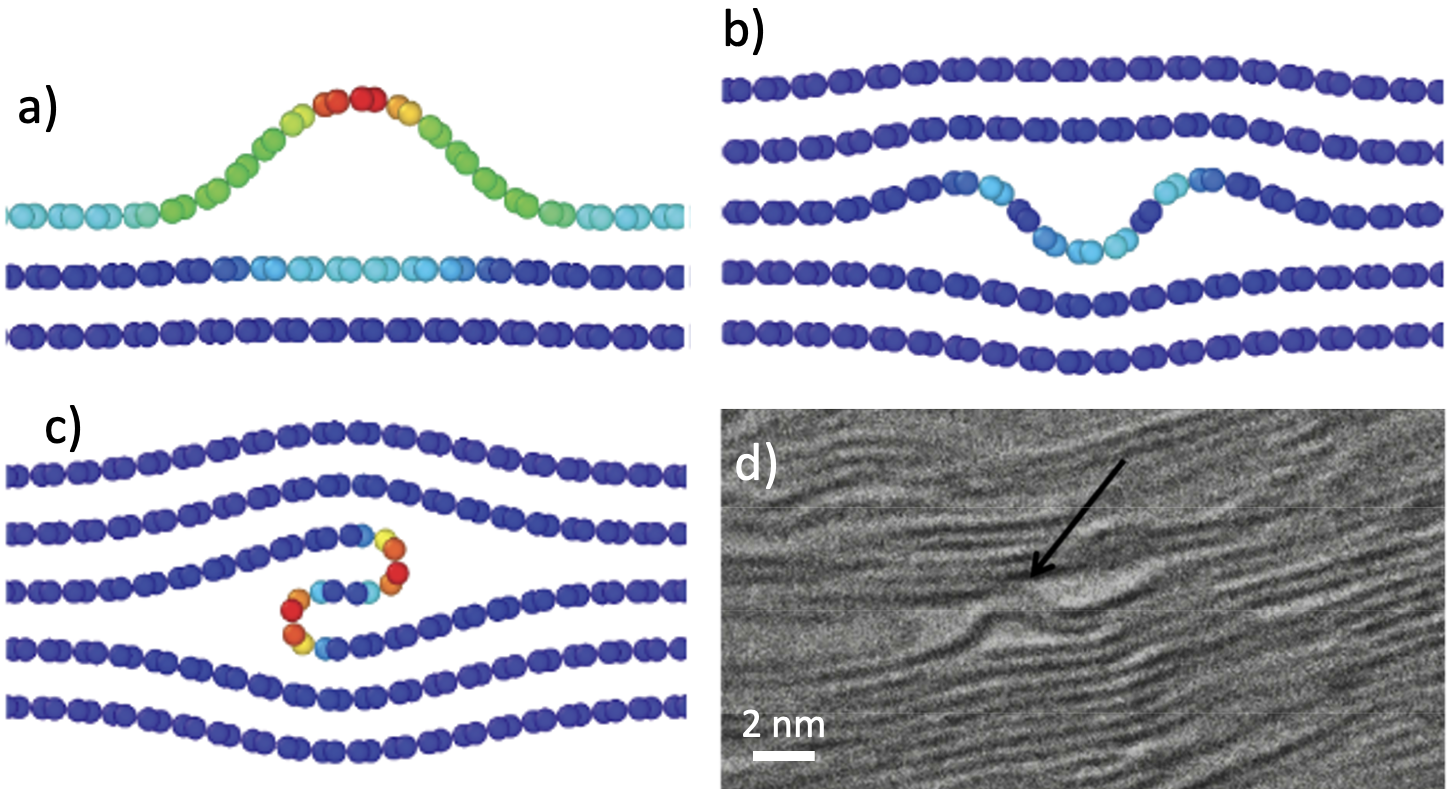
Figure 1:Ripplocation Structures
(a,b,c) Ripplocation structures predicted by simulation in graphite. (d) TEM imaging of neutron-irradiated graphite revealed similar structures, here showing one identical to (b).
Ripplocation-Dislocation Strain Field Comparison
To distinguish ripplocations from dislocations, we looked at their strain fields. Ripplocations require the same stress condition as basal dislocation dipoles, but the resulting defect strain fields are wildly different. Ripplocation strain fields do share some similarities with prismatic dipoles, which are relatively rare and require a different stress state to form.
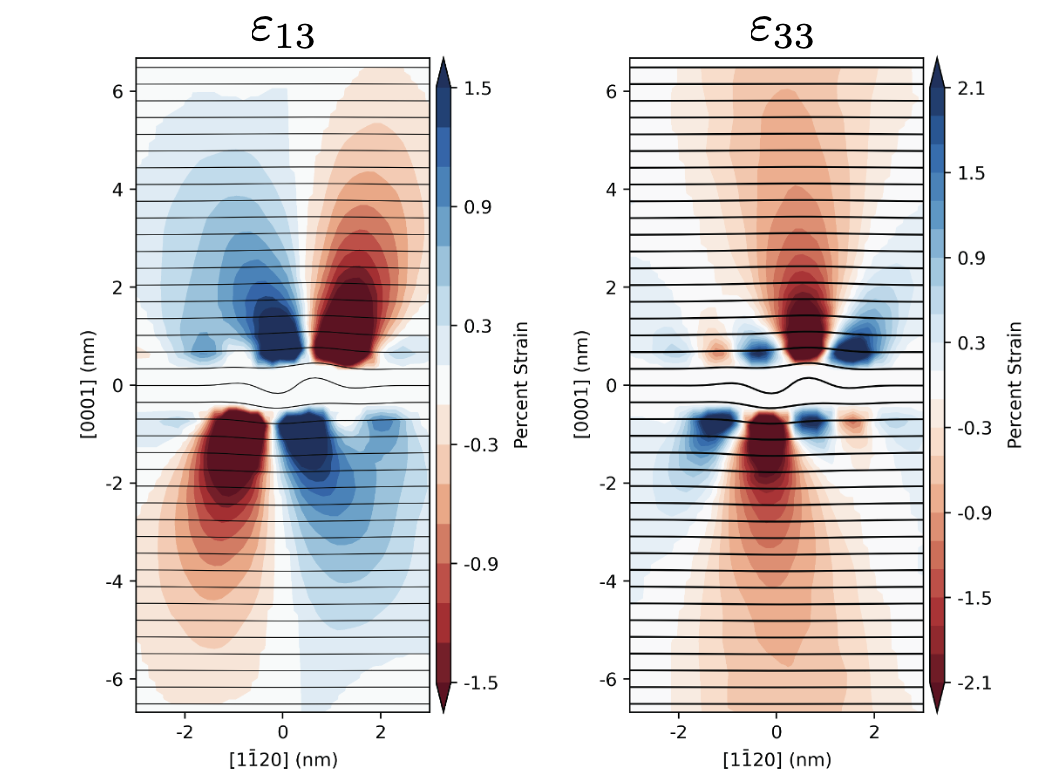
Figure 2:strain_dipole_basal_e13
Strain fields of dislocation dipoles and a ripplocation.
Ripplocation Dynamism
In order to act as a deformation mechanisms analogous to dislocations, we tried to fit these buckles into the mold of a line defect with a mobility that could move in response to external stimulus. Before even considering mobility, however, we found that ripplocationw spontaneously changed configuration even at relatively low temperatures.
Figure 3:alive
Ripplocations are dynamic, moving and chainging configuration at quite low temperatures.
Ripplocation-Ripplocation Interactions
While ripplocations responded to a variety of external stimuli, the most interesting was their response to each other. While dislocations generally repel other identical ripplcations, our simulations reveal that ripplocations present on the same layer spontaenously combine into a larger ripple. And when present on adjacent layers, ripplocations also combine/align such that a single defect spans multiple layers. Notably, the resulting configuration is significantly more energetically favorable than two isolated ripplocations, representing only a slight increase over a single ripplocation.
Figure 4:interaction_ripp_same
Ripplocations present on the same layer spontaenously combine into a larger ripple.
Figure 5:interaction_ripp_adj
Ripplocations on adjacent layers combine/align to form a multi-layer buckled region.
Conclusion
These observations hinted that the single-layer ripplocation might not be the fundamental unit of deformation. The strong tendency for neighboring ripplocations to merge and align motivated later studies of collective buckling, where many graphite layers deform cooperatively in response to applied load.